Introduction
Percentage increase and decrease calculations are useful whenever you want to understand how much a value has changed.
For example, you may want to know:
- How much a product price increased
- How much discount was given
- How much your salary increased
- How much sales grew or declined
- How much a score changed
- How much one value changed compared with another
The good news is that percentage change can be calculated using a simple formula.
What Is Percentage Increase?
Percentage increase tells you how much a value has increased compared with its original value.
The basic formula is:
Percentage Increase = ((New Value − Original Value) ÷ Original Value) × 100
Example
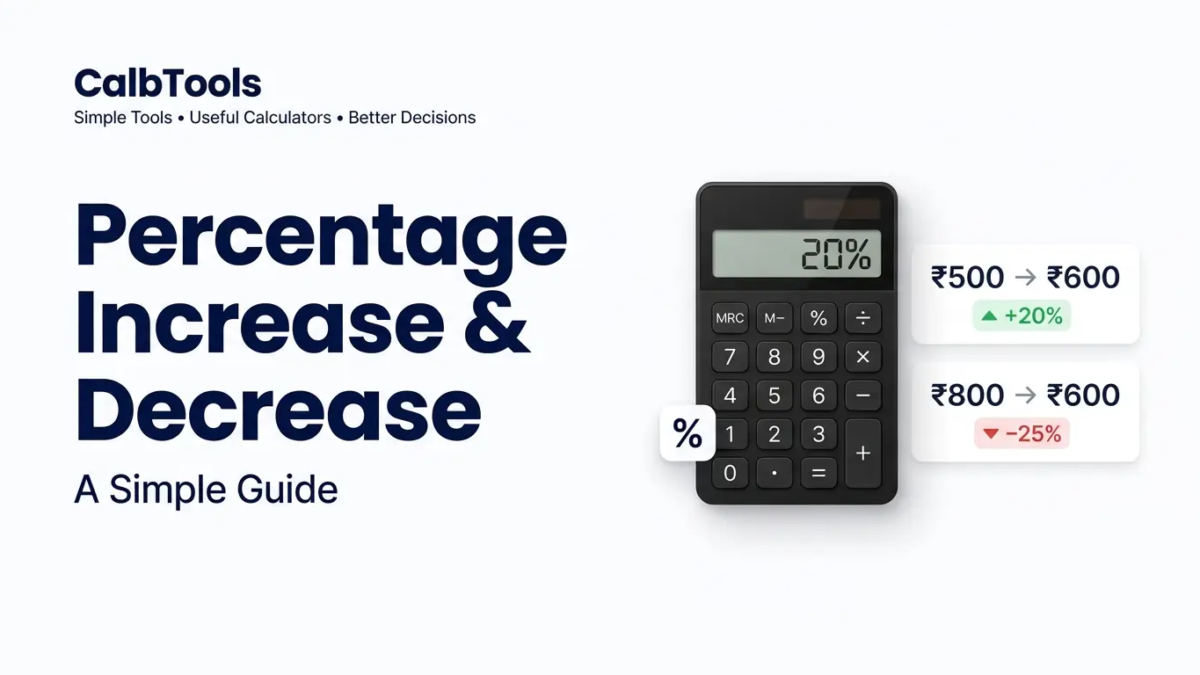
Suppose the price of a product increased from ₹500 to ₹600.
First, find the increase:
₹600 − ₹500 = ₹100
Now divide the increase by the original price:
₹100 ÷ ₹500 = 0.20
Multiply by 100:
0.20 × 100 = 20%
So, the price increased by 20%.
What Is Percentage Decrease?
Percentage decrease tells you how much a value has decreased compared with its original value.
The formula is:
Percentage Decrease = ((Original Value − New Value) ÷ Original Value) × 100
Example
Suppose the price of a product decreases from ₹800 to ₹600.
First, find the decrease:
₹800 − ₹600 = ₹200
Now divide the decrease by the original price:
₹200 ÷ ₹800 = 0.25
Multiply by 100:
0.25 × 100 = 25%
Therefore, the price decreased by 25%.
Percentage Increase vs Percentage Decrease
The main difference is the direction of the change.
| Situation | Formula |
|---|---|
| Value increases | (New − Original) ÷ Original × 100 |
| Value decreases | (Original − New) ÷ Original × 100 |
In both cases, the original value is used as the starting point.
This is important because using the new value instead of the original value can produce a different result.
A Simple Shopping Example
Imagine that a pair of shoes originally costs ₹2,000 and the price later becomes ₹2,400.
The increase is:
₹2,400 − ₹2,000 = ₹400
Percentage increase:
(₹400 ÷ ₹2,000) × 100 = 20%
So, the price increased by 20%.
Now imagine the same shoes are discounted from ₹2,000 to ₹1,600.
The decrease is:
₹2,000 − ₹1,600 = ₹400
Percentage decrease:
(₹400 ÷ ₹2,000) × 100 = 20%
So, the price decreased by 20%.
This example also shows why the original price matters when calculating percentage change.
How to Calculate Percentage Change Quickly
You can follow these three steps:
Step 1: Identify the original value.
Step 2: Find the difference between the original and new value.
Step 3: Divide the difference by the original value and multiply by 100.
For an increase, use the new value minus the original value.
For a decrease, use the original value minus the new value.
Common Mistakes to Avoid
Percentage calculations can become confusing when the wrong starting value is used.
Here are some common mistakes:
Using the New Value Instead of the Original Value
Percentage increase and decrease normally use the original value as the base.
Forgetting to Multiply by 100
A decimal result such as 0.25 represents 25%, not 0.25%.
Confusing Amount Change With Percentage Change
If a price increases from ₹500 to ₹600, the amount of increase is ₹100, while the percentage increase is 20%.
Both are useful, but they represent different things.
Assuming the Same Percentage Works in Reverse
A 20% increase followed by a 20% decrease does not necessarily return a value to its original amount because the second percentage is calculated from a different base.
When Are Percentage Increase and Decrease Calculations Useful?
These calculations are commonly useful for:
- Shopping and discounts
- Salary comparisons
- Business sales
- Price changes
- Exam results
- Budget planning
- Financial comparisons
- Performance tracking
- Year-to-year comparisons
Understanding the percentage change can make it easier to compare values that are different in size.
Use an Online Percentage Calculator
For one simple calculation, the formula is usually enough. But when you need to perform several calculations, an online calculator can save time.
The CalbTools Calculators section provides practical calculators designed to make everyday calculations easier.
Explore CalbTools Calculators →https://calbtools.com/calculators/
You can use an online calculator to quickly check your result after calculating it manually.
Final Takeaway
Percentage increase and decrease are useful ways to understand how much a value has changed.
Remember the basic idea:
Increase: compare the increase with the original value.
Decrease: compare the decrease with the original value.
Once you understand which value should be used as the starting point, percentage change calculations become much easier.
For quick calculations, you can also use an online percentage calculator to save time and check your result.
Related Article
How to Calculate Percentage Easily: A Simple Guide